
The reason its easier to run barefoot is because there’s a natural tendency to avoid a hard-hitting heel strike, and instead, forces you to land with a soft, more responsive forefoot strike, which is the hallmark of reducing injurious impacts. This is why running barefoot feels and is better because you are landing more safely and swiftly as compared with conventional running shoes.
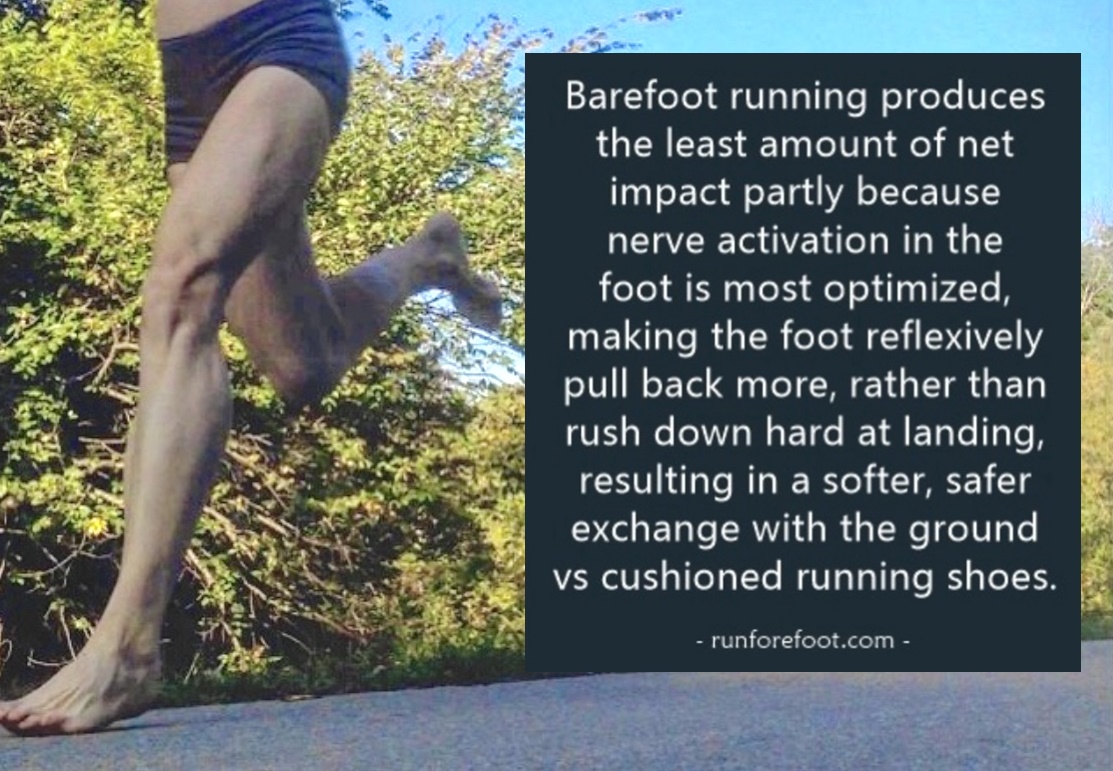

Barefoot expert, Dr. Steven Robbins MD, has confirmed repeatedly that running barefoot directly activates certain foot nerves that are key in translating the heightened sensory input into optimal impact reduction, enabling barefoot runners to get a higher return on avoiding injury than shod (shoe) runners.
More specifically, Dr. Robbins MD discovered that when stimulated during barefoot running, the nerves in the bottom of the feet are better at regulating motor control to protect from high impact by activating the impact avoidance behaviour reflex, resulting in a softer, safer exchange of the foot with the ground vs cushioned running shoes.
- According to Robbins, the noxious sensitive nerves in the feet are most activated during barefoot running which in turn activates the reflex loop in the spinal cord to enable you to strike the ground with an improved forefoot strike that prevents the kind of impact that causes long bone injuries!
-
- Cushioned running shoes block the sensations on the noxious nerves, which interrupts sensory signals from the feet to the impact-reducing reflex loop in the spinal cord. This slows leg withdrawal, resulting in a greater downward force as well as longer ground-contact time which increases the likelihood of over-pronation.

The Take Home Message
We need to acknowledge the most common concern in running is that despite all the advancements in running shoe cushioning, injury rates consistently remain high because you don’t have the strong sensory feedback that helps you use the reflexes tied to having as much impact protection as possible.
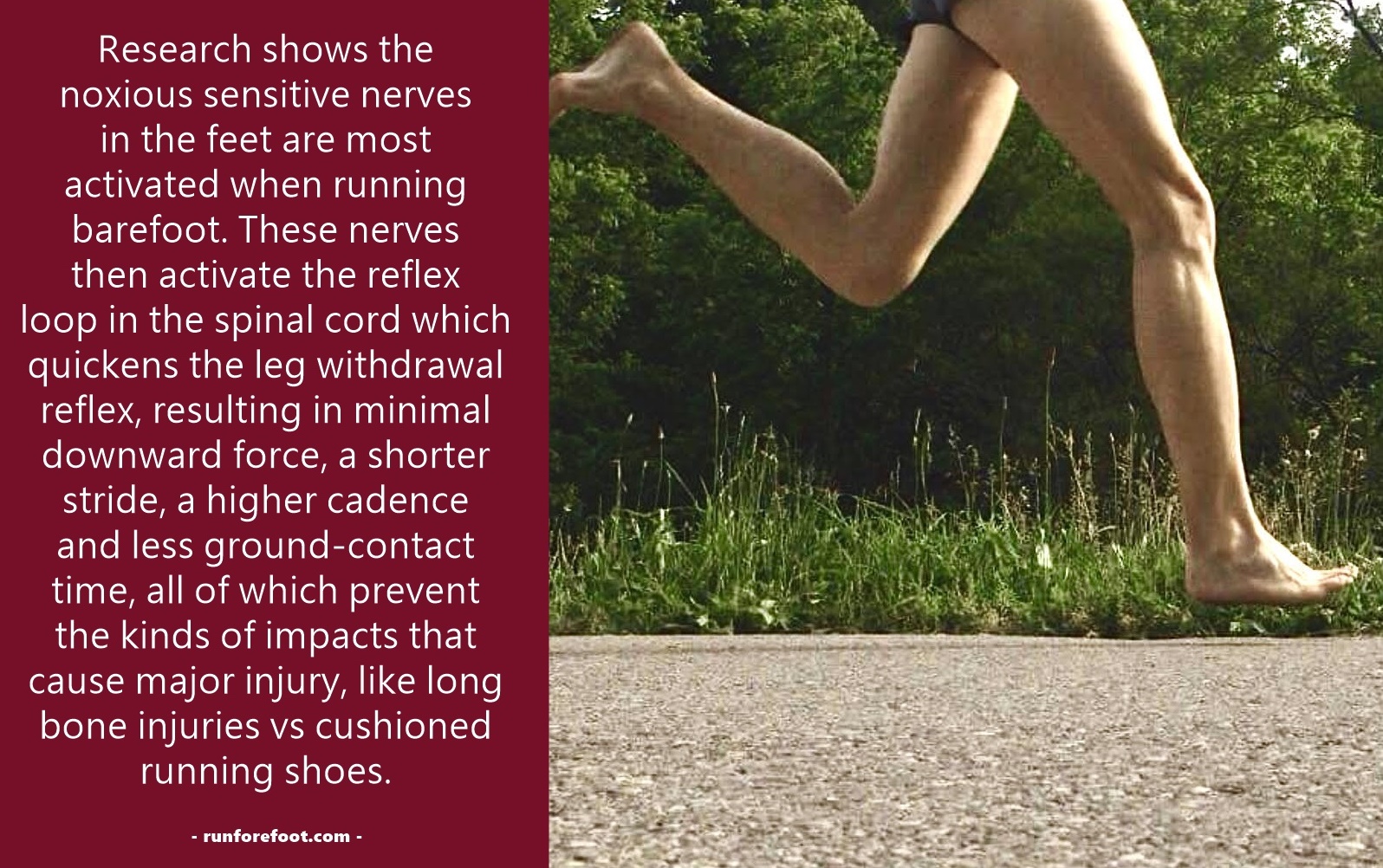
To run at your mechanical best and safeness, the noxious sensitive nerves and therefore the spinal reflex loop needs to be switched on, which can only happen when barefoot!
References:
Robbins et al. Overload protection: avoidance behavior response to heavy plantar surface loading. Med Sci Sport Exer, 1988; 20(1):85-92.
Robbins, S. E and Hanna, A. M. Running related injury prevention through barefoot adaptations. Med Sci Sports Exerc, 1987; 19, 148-165.